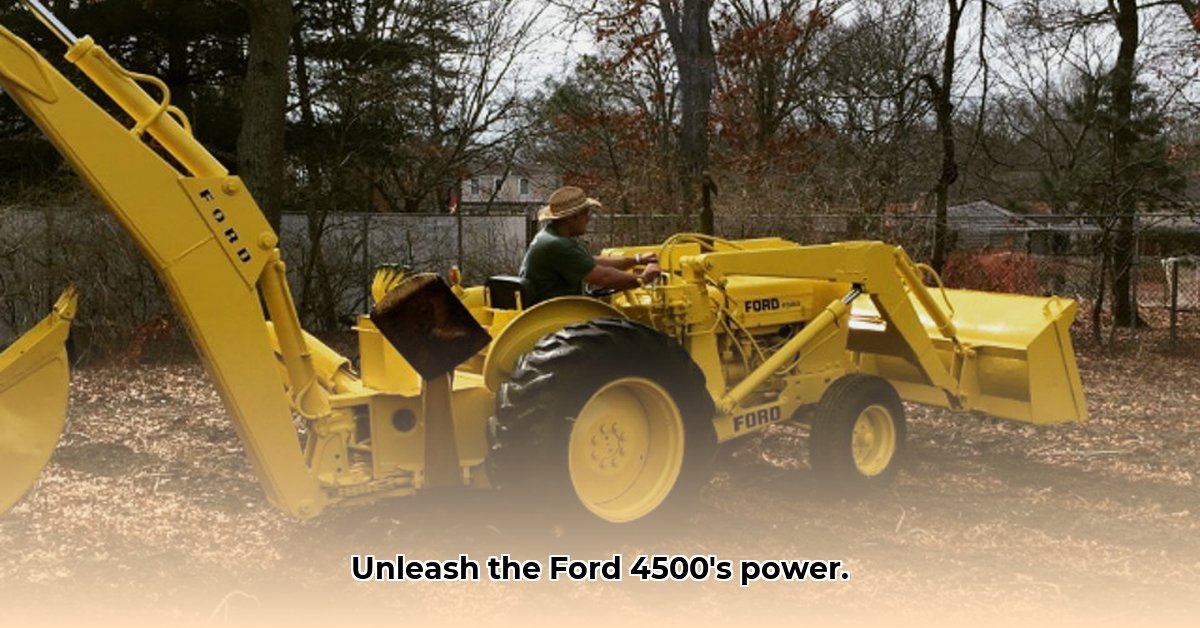
The Ford 4500, produced between 1965 and 1975, represents a significant chapter in agricultural machinery. Its versatility, stemming from diverse engine and transmission options, and its capacity for various attachments, cemented its reputation as a reliable workhorse. However, comprehensive and consistent specifications remain elusive, necessitating a critical review of available data. This guide aims to provide a concise overview, highlighting data gaps and offering actionable recommendations. For more in-depth information, check out this Ford 4500 resource.
A Historical Overview: The Ford 4500's Legacy
The Ford 4500 emerged during a period of evolving agricultural needs. Its adaptable design, allowing for different engine and transmission configurations, contributed to its widespread adoption. The ability to utilize a range of implements further enhanced its practicality. However, inconsistencies in historical records pose a challenge in precisely documenting its specifications across different model variations.
Powertrain Specifications: Engine and Transmission Options
The Ford 4500 offered two primary engine choices: a 3.3-liter, 3-cylinder diesel and a 3.1-liter, 3-cylinder gasoline engine. Horsepower ratings vary significantly depending on the source and methodology (gross vs. net horsepower). This discrepancy points to the need for standardization in data reporting and calls for further investigation into original Ford documentation to resolve inconsistencies. The available transmission options included 4-speed, 6-speed, 8-speed, and 10-speed configurations, some featuring power shuttles, each impacting the tractor's operational characteristics. Further research is needed to fully quantify the performance differences associated with these variations.
Attachment Capabilities: Expanding Operational Versatility
The Ford 4500's three-point hitch system allowed for the attachment of numerous implements. The Ford 755 backhoe is a commonly cited example. However, a comprehensive list of compatible attachments, along with their respective weight and power requirements, remains incomplete. This data void limits a complete understanding of the tractor's full operational potential. What other attachments could be used effectively?
Data Gaps and Discrepancies: Addressing Inconsistencies
A major challenge in documenting the Ford 4500's features lies in the inconsistent reporting of data across various sources. The following table illustrates these discrepancies:
| Feature | Source A | Source B | Discrepancy |
|---|---|---|---|
| Diesel Horsepower | 58.2 hp (gross) | 57.3 PS (net) | Gross vs. net power; different units |
| Gasoline Horsepower | 55.3 hp (gross) | 59 PS (net) | Gross vs. net power; different units |
| PTO Horsepower (Gasoline) | 45.4 hp | Not Available | Missing data from one source |
| PTO Horsepower (Diesel) | 45.6 hp | Not Available | Missing data from one source |
These inconsistencies highlight the need for further investigation into original manufacturer documents and potentially archived testing data.
Actionable Recommendations: Addressing Information Gaps
To improve our understanding of the Ford 4500, several actions are recommended:
Systematic Data Collection: A comprehensive review of original Ford documentation, service manuals, and potentially archived test reports is crucial to resolving inconsistencies and compiling complete specifications.
Expert Consultation: Engaging with experienced Ford 4500 owners, mechanics, and collectors can provide valuable insights and potentially uncover missing information.
Standardized Reporting Practices: To prevent future inaccuracies, the agricultural machinery industry should adopt a standardized method for reporting tractor specifications.
How to Identify Compatible Attachments for Your Ford 4500
The Ford 4500's utility significantly depends on the proper selection of attachments. Ensuring compatibility is vital for both performance and safety.
A Step-by-Step Guide to Attachment Compatibility
Consult the Owner's Manual: The owner's manual provides crucial information about the tractor's weight, lift, and PTO capacities. These factors are fundamental in determining compatibility.
Review Attachment Specifications: Carefully examine the weight, lift requirements, and PTO horsepower needs of any potential attachment.
Direct Comparison: Compare the attachment's specifications against your tractor's capabilities. Inconsistencies indicate potential incompatibility.
Consult Suppliers: Contact suppliers for expert advice. Their knowledge and detailed compatibility charts are invaluable.
Consider the Task: The intended application – material handling, digging, etc. – will dictate appropriate attachment selection.
Prioritize Safety: Never operate with attachments that exceed the tractor's capabilities. Overloading poses significant risks.
Attachment Compatibility Examples
Front-end loaders (such as the model 740) and backhoes (753, 755, and side-shift variations) are frequently used with the Ford 4500, but always verify specifications. The age and condition of your tractor can also influence its capabilities.
Risk Assessment Matrix
| Attachment Type | Risk Factor (1-5) | Mitigation Strategies |
|---|---|---|
| Front-End Loader | 3 | Regular inspections, adherence to weight limits |
| Backhoe | 4 | Proper stabilization, operator training, regular maintenance |
| Side-Shift Backhoe | 4 | Added caution due to the side-shifting mechanism; follow the same as above. |
Key Takeaway: Understanding your tractor's limitations and verifying compatibility are paramount for safe and efficient operation. Always refer to the owner's manual and consult with equipment suppliers or experienced mechanics when in doubt.
[1Everything Attachments. Ford 4500 Attachments Specs. https://www.everythingattachments.com/Ford-4500-Attachments-Specs-s/4589.htm (Accessed: 2025-03-23)]